The impaled object works — unknown to you — as a plug pressing on the very vessels it cut. Pulling it can turn contained bleeding into torrential bleeding you cannot stop. Removal is an operating-room task, where bleeding can be controlled the moment it's withdrawn.
In short — what to do
- Call 998 immediately — describe the object's location and size.
- Stabilise it as it is: place folded dressings or cloth around its base from both sides, secured with tape or a bandage without pressing the object itself.
- Control bleeding around it: press the wound edges around the object, never on top of it.
- Minimise the person's movement — every movement moves the object inside.
- No food or drink — surgery is likely coming.
- A very large object (rod, pole)? Don't cut it yourself — ambulance and fire teams do that with tools that don't shake it.
This topic’s video is coming soon on our channels — follow us
@lahzaem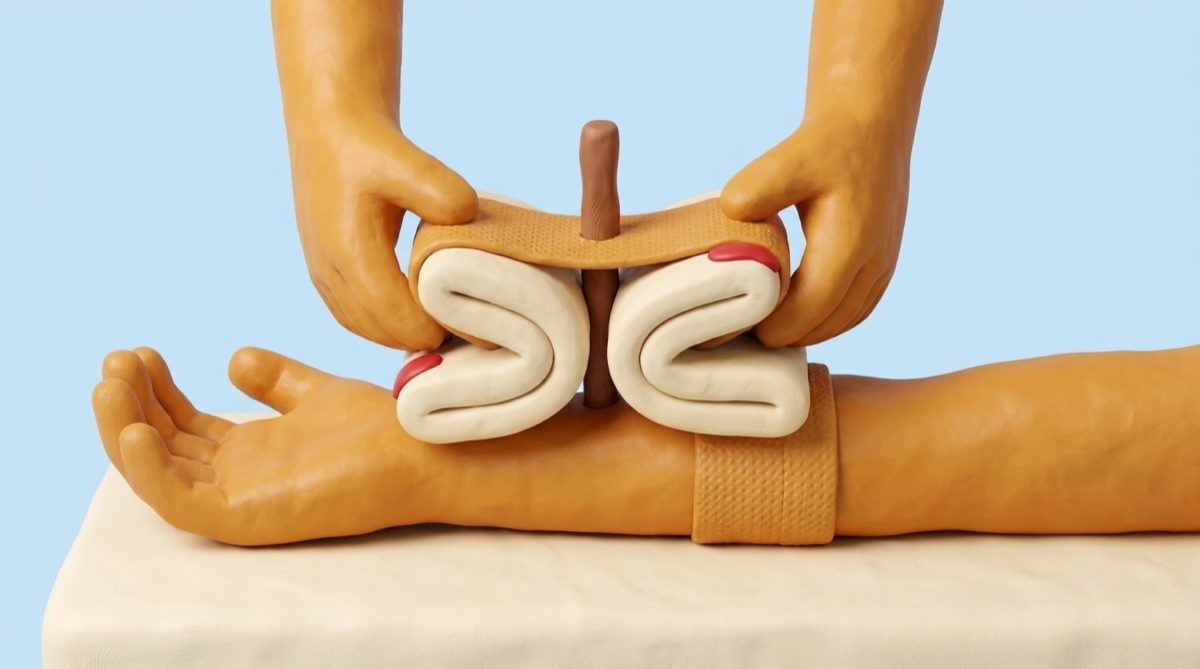
What to do
- Call 998 immediately — describe the object's location and size.
- Stabilise it as it is: place folded dressings or cloth around its base from both sides, secured with tape or a bandage without pressing the object itself.
- Control bleeding around it: press the wound edges around the object, never on top of it.
- Minimise the person's movement — every movement moves the object inside.
- No food or drink — surgery is likely coming.
- A very large object (rod, pole)? Don't cut it yourself — ambulance and fire teams do that with tools that don't shake it.
The single exception
A tiny superficial object (a thorn, a small glass splinter in surface skin) comes out with clean tweezers, then washing and pressure — but anything in the chest, abdomen, neck, eye, or deep in a limb: the full rule applies, however "simple" it looks.
 Watch out
- An impaled object in the chest with breathing difficulty: stabilise it and leave the person in whatever position eases their breathing until the team arrives.
- Don't probe the wound's depth or wiggle the object "to see" — curiosity kills here.
One moment
The hardest first aid is the kind where you "don't do": your hand holding padding around the object, and your reassuring voice — these are your complete achievement until the team arrives.
This content is for general health education only and is not medical advice. Always seek guidance from a qualified healthcare professional. In an emergency, call 998.