Drowning is a leading cause of child death in our region, mostly in home pools and under adults' eyes. A child drowns in under a minute, in complete silence.
In short — what to do
- Have someone call 998 and fetch an AED if available.
- Check: responding? breathing normally?
- Not breathing? Start CPR immediately — and in drowning specifically: if trained, start with 5 rescue breaths then compressions; if untrained, do continuous chest compressions.
- Breathing but unconscious? Recovery position, and watch the breathing.
- Remove wet clothes and keep them warm.
- Anyone who nearly drowned and "seems fine" but then coughs, gets drowsy or short of breath needs ER assessment — lung problems can be delayed by hours.
This topic’s video is coming soon on our channels — follow us
@lahzaem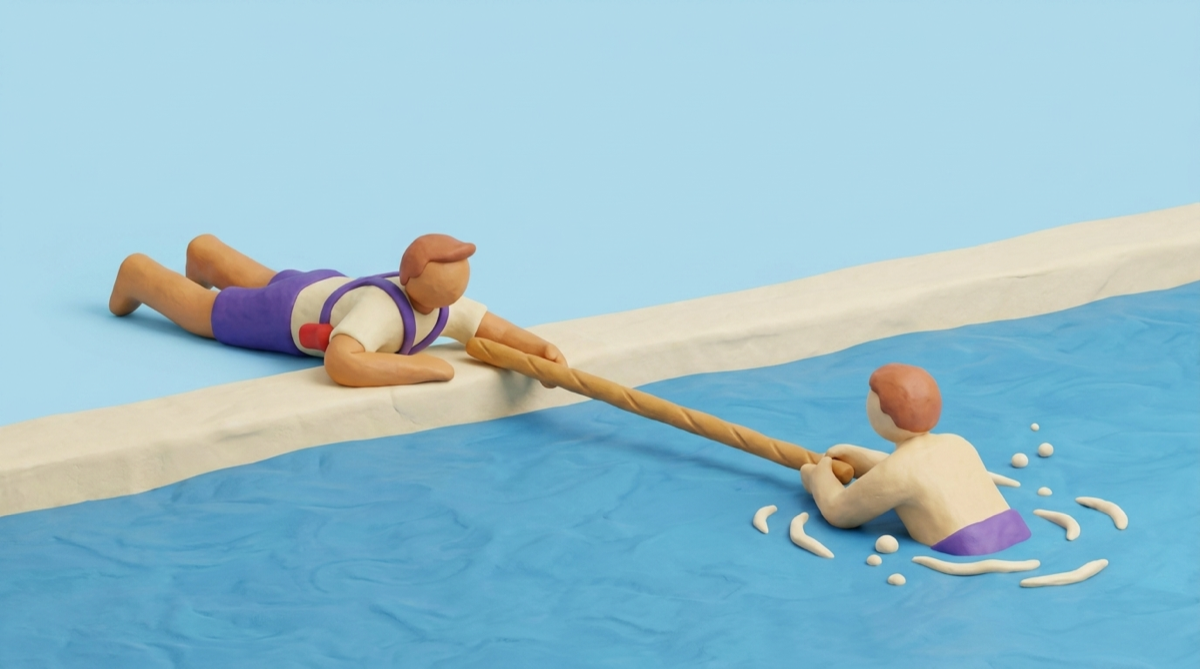
The full details
You got them out of the water — now what?
- Have someone call 998 and fetch an AED if available.
- Check: responding? breathing normally?
- Not breathing? Start CPR immediately — and in drowning specifically: if trained, start with 5 rescue breaths then compressions; if untrained, do continuous chest compressions.
- Breathing but unconscious? Recovery position, and watch the breathing.
- Remove wet clothes and keep them warm.
- Anyone who nearly drowned and "seems fine" but then coughs, gets drowsy or short of breath needs ER assessment — lung problems can be delayed by hours.
Safe rescue rules
- Reach or throw — don't go unless you're a trained rescuer: a pole, a towel, a ring, a rope.
- A panicking drowning person sinks their rescuer — approach from behind if you must enter.
- No abdominal thrusts "to get the water out" — a myth that wastes CPR time.
 At home
- An adult's arm-length is the safety distance: child in water = eyes never leave them, phone far away.
- Floaties are not protection — a pool fence and a locked gate are.
- Paddling pools and buckets: an infant drowns in 5 cm of water.
The investment of a lifetime
Teach your children to swim early, and learn CPR yourself — most people saved by CPR after drowning are children saved by their own families.
This content is for general health education only and is not medical advice. Always seek guidance from a qualified healthcare professional. In an emergency, call 998.